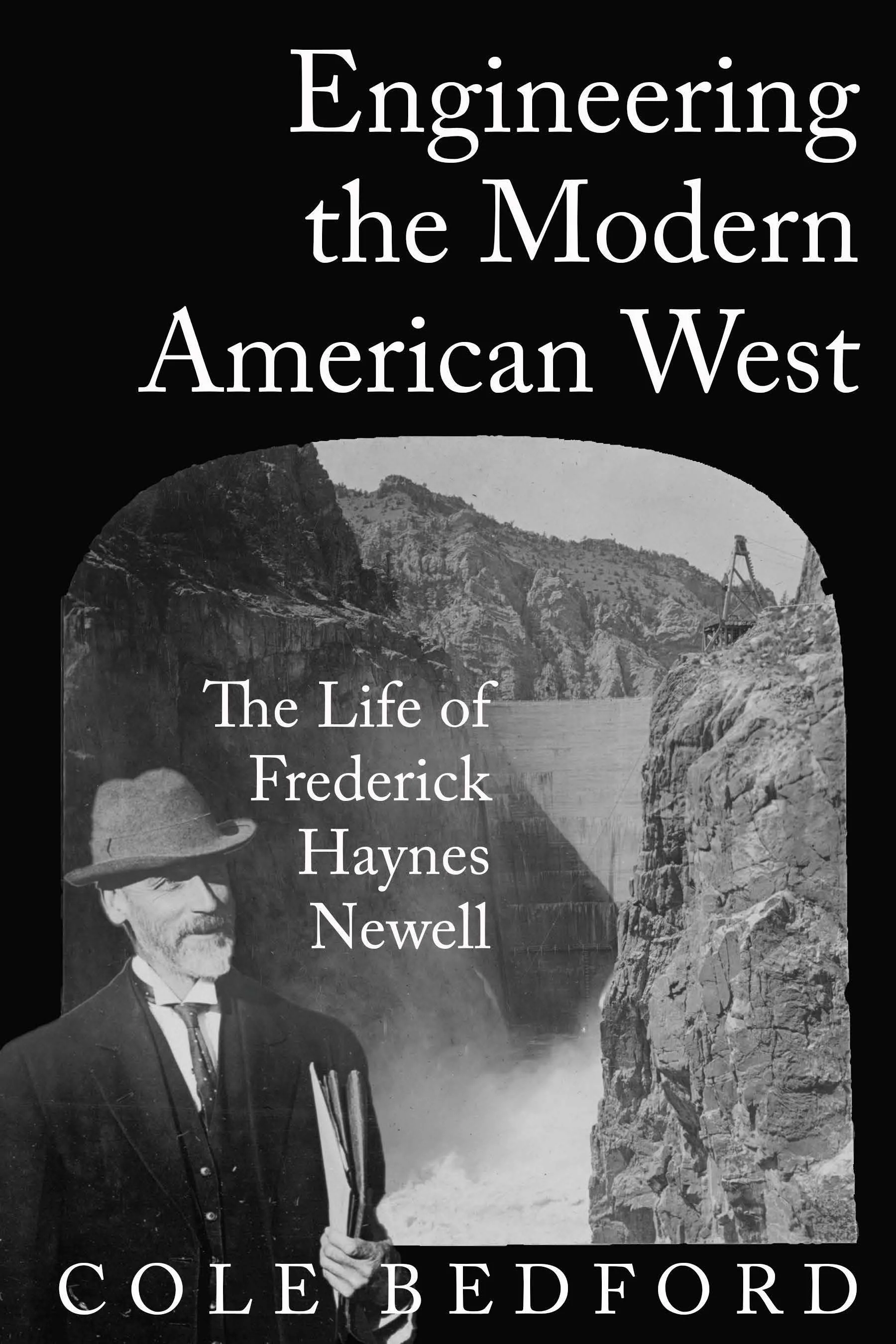
Engineering the Modern American West
Coming June 2026
Engineering the Modern American West:
The Life of Frederick Haynes Newell
During the second half of the 19th century, Americans dramatically altered the landscape of the arid American West―especially its precious few rivers. Engineers built ever more ambitious dams, canals, diversions, and reservoirs until, by the dawn of the 20th century, only the federal government wielded the resources needed to continue the development.
At the forefront of the federal effort was Frederick Haynes Newell: son of a rambling New England businessman, graduate of MIT, advisor to Theodore Roosevelt, and prophet for scientific conservation of natural resources. For more than twenty-five years, Newell defined the federal government’s role in Western water.
Newell’s unlikely rise to power as the first leader of the Bureau of Reclamation and his subsequent fall from grace is a story not well remembered. His influence, however, is imprinted on every facet of the incomprehensibly complex system manipulating the West’s water.
Ralph Waldo Emerson wrote that “every great institution is the lengthened shadow of a single man. His character determines the character of the organization.” If the Bureau of Reclamation―with its landscape-scale infrastructure and herculean feats of water management―can be said to be the lengthened shadow of one man, that man is Frederick Haynes Newell.
-
Engineering the Modern American West is available for pre-order through the Texas Tech University Press and Amazon.com
-
While Engineering the Modern American West covers the whole span of Newell’s life, it especially considers him with respect to his impact on Western water development. It first considers his uniquely roving childhood and his education at the Massachusetts Institute of Technology. Then, Newell’s early career traveling the West as the United States Geological Survey’s Chief Hydrographer convinced him that the nineteenth century’s laissez-faire attitude toward Western development would not suffice in the next century. He brought all this experience with him when he was placed at the helm of the Reclamation Service in 1902 and, for the next twelve years, Newell built up the organization in his image.
-
For historians of the American West, water is the perennial theme. In the 1930s, Walter Prescott Webb saw aridity as the stubborn fact that bent American institutions around it. For Wallace Stegner in the 1950s, the lack of precipitation was the only unifying feature of a West comprised of otherwise disconnected sub-regions. By the 1980s, writers like Donald Worster and Marc Reisner questioned fundamental assumptions about our relationship to the Western environment and the wisdom of our approach to settlement. No matter how we turn it over, inspect it from a new direction, or through a new lens, we learn something new by examining our relationship with the West’s water. Past historians considered grand themes and broad patterns, but—with the notable exception of John Wesley Powell—the actual men and women involved, those who made the decisions and wielded the power to influence the course of events, have been largely neglected.
-
Engineering the Modern American West is working through the publication process and will be available in June 2026. Contact the author HERE to receive notification when it publishes.